

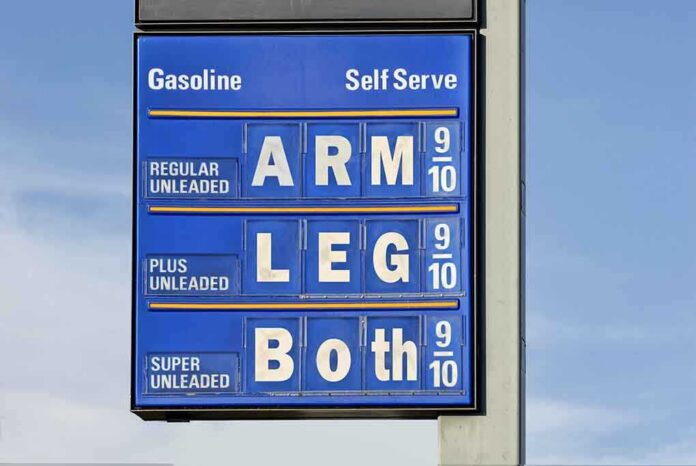
California motorists are paying over $7 per gallon at select gas stations as Middle Eastern conflict disrupts oil tanker routes, exposing the Golden State’s vulnerability to foreign supply dependence and regulatory constraints that prevent relief.
Story Snapshot
- California’s average gas price hits $6.11 per gallon—54% above the national average of $3.97—with some stations charging over $8.71 per gallon
- U.S. and Israeli military strikes against Iran in March 2026 tripled tanker shipping costs, driving California’s import-dependent fuel market into crisis
- State regulators launched price-gouging investigations while experts warn prices could reach $8.43 per gallon with no resolution in sight
- Low-income families now spend 8-10% of household income on fuel as California’s pipeline isolation and environmental regulations compound supply problems
Geopolitical Shocks Hit California’s Isolated Fuel Market
California’s gasoline prices surged to an average of $6.11 per gallon in May 2026, driven by military strikes against Iran that disrupted global oil supply chains. The state imports over 60% of its petroleum via tanker ships from Middle Eastern and foreign sources, making it uniquely vulnerable to international conflicts. Tanker shipping costs tripled following the March 2026 U.S.-Israeli strikes against Iran, forcing California drivers to absorb costs that exceeded the national average by $2.14 per gallon. Individual stations in remote coastal areas like Gorda charged $8.50 for premium fuel, while a downtown Los Angeles Chevron reached $8.71 per gallon.
Structural Vulnerabilities Compound Consumer Pain
California operates without pipeline connections to major U.S. oil refineries in Texas or Oklahoma, relying entirely on tanker imports and limited in-state refining capacity. The state’s strict environmental regulations require specialized fuel formulations that few refineries can produce, further restricting supply sources. The summer-blend gasoline transition added 15-17 cents per gallon beginning in April, compounding price increases. USC Energy Institute analyst Michael Mahey predicted worst-case scenarios reaching $8.43 per gallon, while California Forward CEO Kate Gordon warned that “$10 gas is not out of the question under certain conditions.” These structural constraints—built over decades of regulatory decision-making—leave California drivers with no immediate relief options.
Low-Income Families Bear Disproportionate Burden
Households earning under $50,000 annually now spend 8-10% of their income on fuel, compared to 2-3% for higher earners, creating a regressive economic burden that hits working families hardest. Average California drivers face $200-300 in additional monthly fuel costs compared to May 2025, forcing cuts to discretionary spending on groceries, healthcare, and savings. Commercial truckers, delivery drivers, and small businesses dependent on transportation absorb 15-25% cost increases with limited ability to pass expenses to consumers. Rural communities with longer commutes and no public transit alternatives face the steepest challenges, while remote workers and electric vehicle owners remain largely insulated from the crisis.
Political Blame Game Offers No Solutions
Governor Gavin Newsom blamed the Trump administration’s Iran policy for triggering “global price shocks” with “no plan to protect families,” while state regulators launched price-gouging investigations targeting stations charging $7-$8 per gallon. However, market fundamentals—not speculation—drive the increases: tripled tanker costs, summer-blend premiums, and ongoing Middle Eastern supply uncertainty represent legitimate cost pass-throughs. California’s Division of Petroleum Market Oversight faces difficulty distinguishing gouging from supply-driven pricing, possessing limited enforcement tools to address geopolitical disruptions. Newsom rejected increased drilling as a solution, leaving consumers trapped between federal foreign policy decisions beyond state control and state regulations that prevent supply alternatives like pipeline connections to domestic refineries in Texas or Oklahoma.
Expert Consensus: No Relief Until Conflict Resolves
Energy analysts agree prices will remain elevated as long as Iran conflict continues, with no immediate geopolitical resolution visible. AAA documented an 81-cent increase in San Diego prices over one month, noting California already paid more than any other state before the crisis began. The price trajectory stabilized around $6.11-$6.13 averages by May but shows no signs of decline, with seasonal factors preventing relief through September. Long-term implications include accelerated electric vehicle adoption, potential refinery investment, and renewed focus on energy independence—but these structural shifts offer no immediate help to families struggling with today’s gas prices. The crisis exposes decades of policy decisions prioritizing environmental regulations over supply resilience, leaving California motorists vulnerable to every global supply disruption.
Sources:
Gas station in San Francisco charging $7 per gallon – KTVU
Fact or Fiction: California gas station charging $7 per gallon – 10News