

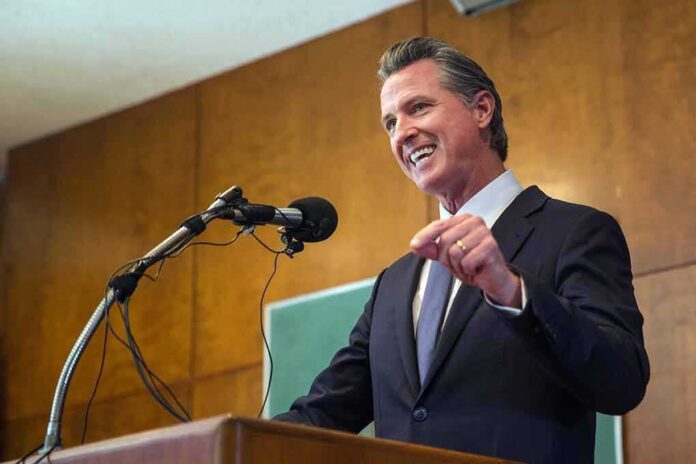
Gavin Newsom’s attempt to “bond” with Black voters by highlighting a low SAT score has exploded into a national controversy—followed by a profanity-laced online meltdown that raises new questions about his judgment as Democrats eye 2028.
Quick Take
- Gavin Newsom drew backlash after telling Atlanta’s mayor “I’m like you” before citing his 960 SAT score and saying he can’t read speeches at a book tour event.
- Sean Hannity criticized the remarks as offensive, and Newsom fired back on X with a curse-filled post defending his lifelong dyslexia struggles.
- Critics argued the messaging sounded like a stereotype about Black academic performance, while supporters framed it as candid self-disclosure.
- The controversy lands as Newsom raises his national profile during a memoir tour that many view as groundwork for a 2028 run.
Book Tour Comments Spark a Fresh “Culture” Flashpoint
Gavin Newsom’s latest headline came from an Atlanta stop on his tour promoting his memoir Young Man in a Hurry, where he appeared to seek common ground with Atlanta Mayor Andre Dickens and the crowd. Newsom told Dickens, “I’m like you. I’m not better than you. I’m a 960 SAT guy,” then added that people never see him read speeches because he “cannot read a speech.” Critics said the wording landed badly given the setting and audience.
The backlash widened because standardized test gaps are a sensitive topic Democrats often link to “equity” debates and school policy fights. Reporting cited College Board 2024 data showing an average SAT score of 907 for Black or African-American test-takers, making Newsom’s “960” only slightly higher. That detail fueled claims that Newsom’s “I’m like you” line sounded like he was tying Black identity to low scores—whether he intended that or not.
Hannity Criticism Meets a Profanity-Laced Counterpunch
Sean Hannity publicly condemned Newsom’s comments, framing them as a “racist gaffe” and an example of elite Democrats speaking down to the very voters they rely on. Newsom did not respond with a formal clarification at the event level, and no apology was reported in the research. Instead, the governor escalated the dispute online, posting an angry reply that accused Hannity of selective outrage and used explicit profanity while insisting the remarks reflected his personal struggles.
Newsom’s defense centered on dyslexia, which he has discussed publicly in the past. In his post, he argued he was talking about his lifelong reading challenges, not making a comment about race, and he tried to flip the charge back at Hannity by referencing past controversies involving President Trump and rhetoric about other countries. The facts available in the research confirm the dyslexia explanation is part of Newsom’s stated intent; what remains unclear is why he chose phrasing that critics say sounded like a demographic comparison.
Nicki Minaj and the “Condescending” Charge
The blowback did not stay inside partisan media. Nicki Minaj weighed in, blasting Newsom’s approach as condescending and portraying it as a politician trying to “bond” by describing himself as “stupid” and unable to read. Her criticism also broadened into a character argument about whether Newsom has been elevated into high positions he “never earned or deserved.” Those are opinions, not independently verified facts, but they illustrate why the episode spread: it combined race, class, and competence questions into one viral clip cycle.
Political Stakes as Democrats Look Past the Biden Era
The timing matters. With President Trump back in office and the Biden administration over, Democrats are already testing possible 2028 brands—especially governors with national ambitions. Newsom’s travel, messaging, and memoir rollout have been widely interpreted as part of that profile-building effort. That makes message discipline more important, not less. The research also notes a lack of statements from Mayor Dickens, Democratic leadership, or community organizations, leaving the story to be shaped largely by social media reactions and partisan outlets.
What’s Known, What’s Missing, and Why It Matters
Multiple sources consistently report the basic timeline: the Atlanta remarks, Hannity’s criticism, and Newsom’s curse-filled response defending himself as dyslexic. Beyond that, key information remains missing—such as full event context, the precise audience composition, and whether Newsom’s team offered any behind-the-scenes clarification. For conservative readers weary of “woke” messaging games, the episode underscores a familiar pattern: Democrats demand careful language from everyone else, then react with anger and deflection when their own rhetoric blows up.
For now, the controversy continues to play out online, with supporters insisting Newsom was sharing a personal hardship and critics arguing he chose a clumsy comparison in a racial context he should have anticipated. If Newsom wants to sell himself nationally as a competent executive, the question is not whether he has dyslexia—it is whether he can communicate clearly under pressure without turning a legitimate concern into another social-media shouting match.