
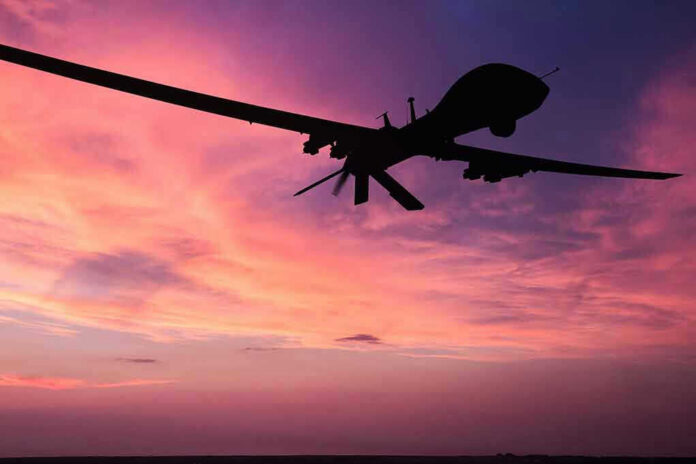
Mexican cartel drones crossing into U.S. airspace near a major Texas airport is the kind of border reality Washington used to downplay—until it forced flights to stop.
Quick Take
- Cartel-linked drones breached U.S. airspace near El Paso International Airport, triggering an FAA shutdown of local airspace on Feb. 10, 2026.
- Transportation Secretary Sean Duffy said the Department of War disabled the drones and the threat was neutralized, allowing flights to resume by Feb. 11.
- Local leaders from both parties criticized the lack of notice and coordination, citing public-safety impacts including medical flight diversions.
- The incident adds pressure for stronger counter-drone enforcement along the border as cartels expand from smuggling to surveillance and airspace disruption.
Cartel drone incursion forces emergency airspace shutdown near El Paso
Federal officials said Mexican drug cartel-operated drones breached U.S. airspace near El Paso International Airport late Feb. 10, prompting the Federal Aviation Administration to issue a temporary flight restriction that halted arrivals and departures. The restriction initially extended through Feb. 20 for “special security reasons,” but the Department of War intervened from the Fort Bliss area and disabled the drones, according to statements later shared by Transportation Secretary Sean Duffy.
By the morning of Feb. 11, Duffy said the FAA and Department of War had acted swiftly, the threat was neutralized, and the flight restriction was lifted. Airlines and general aviation resumed normal operations after the airport closure created immediate disruption for travelers and commerce in a major border metro. Officials have not publicly detailed how many drones were involved or the exact method used to disable them, leaving key operational questions unanswered.
Local officials demand transparency after disruptions to public safety
El Paso-area officials pushed back on how the restriction was implemented, arguing the community received little warning despite major consequences. Rep. Veronica Escobar urged the FAA to lift the restriction, saying there was no immediate threat and emphasizing the lack of notice. El Paso Mayor Renard Johnson also condemned the communication breakdown, pointing to public-safety impacts such as medical flights being diverted to nearby Las Cruces during the closure.
Rep. Tony Gonzales said federal partners indicated there was no continuing security threat and referenced a similar situation in Hudspeth County in November 2025 that was resolved quickly once agencies coordinated. Reporting cited an FAA-briefed source indicating the restriction reflected the Department of War’s inability, at that moment, to guarantee civilian safety while military operations addressed the drones. That explanation underscores a core issue: rapid security action may be necessary, but cities still need real-time coordination when lifesaving services depend on air access.
Border drone use is evolving from smuggling to airspace disruption
Authorities have warned for years that cartels increasingly use commercially available drones for surveillance and smuggling across the border, with activity expanding since roughly 2015. The El Paso–Ciudad Juárez corridor is a high-volume trade and travel gateway, and the proximity of Fort Bliss and Biggs Army Airfield creates both a strategic target and a rapid-response advantage. Officials stressed the incident involved U.S. airspace near a commercial airport and did not affect Mexican airspace.
What the El Paso shutdown signals for aviation security and federal authority
The episode tested FAA and defense coordination in real time and raised broader questions about how quickly federal agencies can—and should—lock down airspace over a major American city. One Texas outlet described the initial length of the proposed restriction as unusual for a major metro area and suggested it was the most significant airspace shutdown comparison since the post-9/11 period. Regardless of comparisons, the bigger takeaway is that cartel capabilities are no longer confined to remote desert crossings.
BREAKING – Mexican cartel drones breached US airspace: US administration official https://t.co/xDrX3KZRrk pic.twitter.com/ysDmeyAPdI
— Insider Paper (@TheInsiderPaper) February 11, 2026
Duffy’s announcement that the drones were disabled and flights resumed will reassure travelers, but it also confirms something border-state families have argued for years: criminal networks adapt faster than bureaucracy. The available reporting does not provide technical specifics on the drones, their payloads, or the operators, and that limits public understanding of the full risk profile. Even so, the incident shows why counter-drone policy and border enforcement are now tightly linked to everyday safety—including the freedom to travel without cartel-linked threats disrupting American skies.
Sources:
Mexican cartel drones breach US airspace near El Paso, disabled by War Department, Duffy says
FAA grounds all flights to and from El Paso until Feb. 20
El Paso air space closed by FAA