
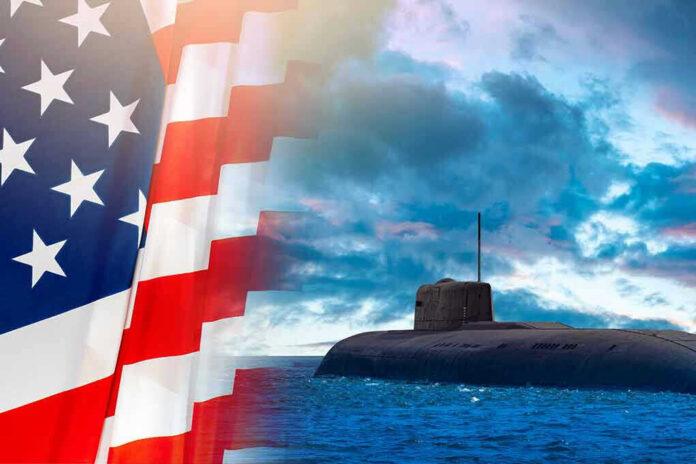
A revolutionary new fleet of submarines is poised to redefine stealth warfare, potentially altering global naval dynamics.
Story Highlights
- The Columbia-class submarines represent a $348 billion investment to enhance U.S. naval capabilities.
- Scheduled to replace the aging Ohio-class, these subs promise unprecedented stealth features.
- Integration of advanced technologies like electric-drive propulsion and drone capabilities.
- Concerns emerge over program delays and budget overruns.
Columbia-Class Submarine’s Cutting-Edge Technology
The Columbia-class submarines are set to usher in a new era of naval warfare with cutting-edge technology designed to ensure U.S. superiority beneath the waves. These submarines, valued at $348 billion, are intended to replace the aging Ohio-class vessels. The Columbia-class showcases advanced stealth features, including electric-drive propulsion and a life-of-the-boat reactor, making it potentially the most stealthy submarine ever constructed. As the U.S. faces increasing threats from global adversaries, this technological leap is crucial for maintaining strategic deterrence.
The Navy’s $348 Billion Columbia-Class Nuclear Missile Submarine Might Be the Most Stealth Sub Everhttps://t.co/kQy2mn75aw
— Harry Kazianis (@GrecianFormula) January 25, 2026
In addition to its stealth capabilities, the Columbia-class also integrates advanced sonar systems and drone technology, enhancing its survivability against modern threats like undersea drones and sophisticated enemy sonar systems. The submarines are constructed with a unique X-stern design to reduce noise and improve maneuverability, drawing on innovations from the Virginia-class submarines. These features collectively make the Columbia-class a formidable component of the U.S. nuclear triad, highlighting America’s commitment to maintaining its military edge.
Challenges and Concerns
Despite the promising advancements, the Columbia-class program is not without its challenges. Budget overruns and construction delays pose significant concerns, particularly as the Navy aims to deliver the first submarine by 2028. The program’s $348 billion price tag places considerable pressure on defense spending, prompting debates within Congress regarding resource allocation between aircraft carriers and submarines. Furthermore, the reduction in missile tubes from 24 in the Ohio-class to 16 in the Columbia-class has raised questions about the overall firepower and strategic deterrence capability.
As construction progresses, the Navy remains focused on integrating the latest quieting technologies to ensure the Columbia-class remains undetectable by adversaries. However, the aspirations of achieving the “most stealth sub ever” status remain untested in operational scenarios, leaving room for skepticism. The Navy’s commitment to delivering these submarines on time and within budget will be critical in maintaining U.S. defense capabilities in the coming decades.
Strategic and Economic Implications
The introduction of the Columbia-class submarines promises significant strategic and economic implications. In the short term, the program has bolstered the industrial base, creating jobs at shipyards like Groton, Connecticut, and Newport News, Virginia. However, the long-term impact is even more profound, as these submarines are expected to remain operational for over 40 years without requiring mid-life refueling. This ensures a reliable and undetectable nuclear deterrence capability through the 2080s, reinforcing the U.S. position against global threats.
Economically, the program’s cost pressures may influence future defense budget allocations, while socially, advancements in quiet technology could ripple into commercial sectors, potentially reducing marine noise pollution. As the Columbia-class submarines set sail, they are poised to influence global submarine design and fortify U.S.-U.K. defense collaborations.
Sources:
Why the Navy’s Columbia-Class Nuclear-Armed Sub May Be the Stealthiest in the World
Columbia-Class Submarine: The Most Stealth Submarine Ever Built?
Columbia-Class Submarine Design
X-Factor: Columbia-Class Submarine Design